A Conversation With Ambassador Jamieson Greer
Event date
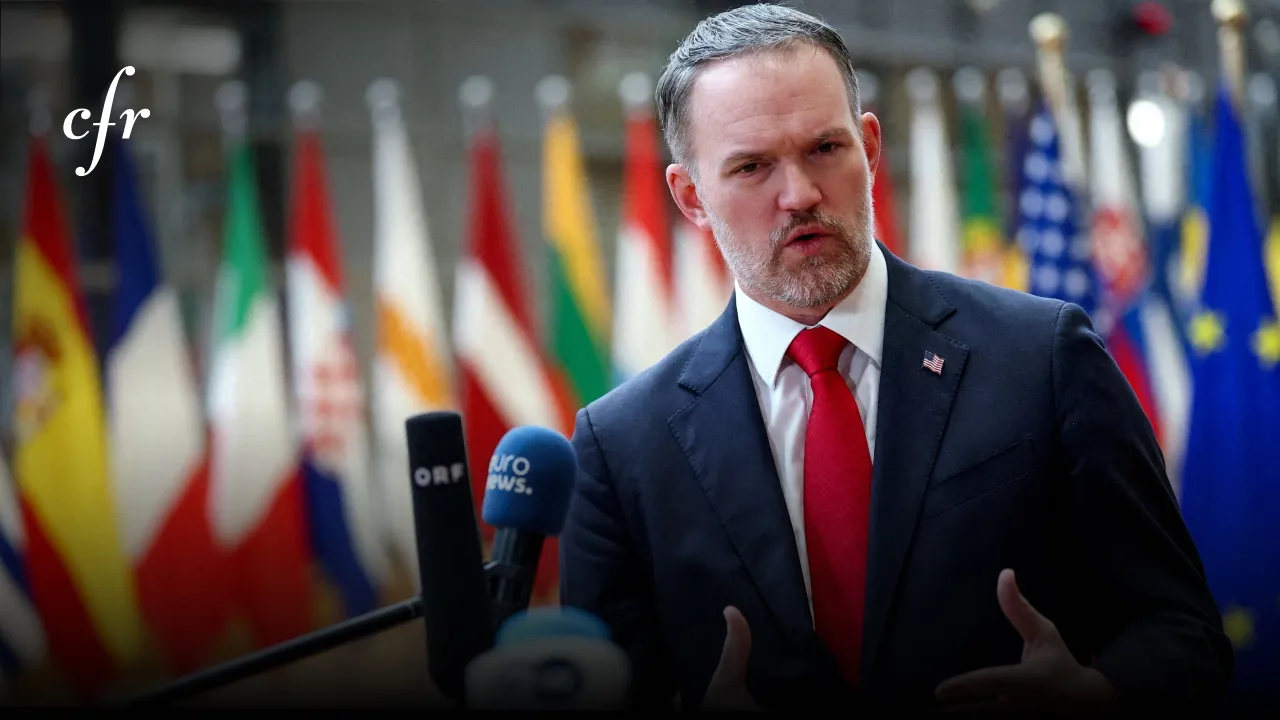
U.S. Trade Representative Ambassador Jamieson Greer discusses recent developments in the administration’s global economic trade strategy.
Please note that this meeting was originally scheduled for Tuesday, April 28, 2026.
The C. Peter McColough Series on International Economics brings the world’s foremost economic policymakers and scholars to address members on current topics in international economics. This meeting series is presented by the Greenberg Center for Geoeconomics.
FROMAN: Well, good afternoon, everybody. Welcome. It’s great to see you all here. In addition to the 120 or so in the room, we have about 300 members online and we’ll take questions from them as well when the time comes.
It’s a great pleasure to welcome back to the Council Ambassador Jamieson Greer, who you all know, as our U.S.—our twentieth USTR. What does that make—I think, does that make me the seventeenth? I think seventeenth. Previously chief of staff to Ambassador Bob Lighthizer during President Trump’s first term. He’s been deeply involved in that administration, in the negotiations with China over the Phase One agreement, and the negotiation of USMCA. And, of course, in this administration he’s really been the point person in charge of everything trade. You’ve been busy.
GREER: We’ve been busy. We have our hands full.
FROMAN: You’ve been busy. One of the things I loved about the job was that it combined the high diplomatic activity of engaging with heads of state over tariffs or nontariff barriers, with getting a real granular understanding of the U.S. economy. I’ll never forget dairy farmers in Wisconsin teaching me the 500 things you can do with a molecule of milk to get around trade barriers in other countries. (Laughter.) Which part of the job do you like best, the domestic or dealing with the diplomacy?
GREER: Well, I would say I like—I’m a homer, right? I mean, America first, that’s why we call it that. And I have been able to spend a lot of time domestically over the past few months going to factories. Last Friday I was at the Micron fab in Manassas, where they just put in an additional 2 billion (dollars). Got to go through the clean rooms, through the facilities, meet with the workers. And that is always really meaningful to me, right? That I get to talk to these folks. And I like to ask the workers, do you have family or friends working at the facility? And almost always they say, yes, right? My uncle worked the line before me, my sister-in-law is in the training department, different things.
And it just—it just drives home that trade is not just, hey, we’re seeking for efficiencies wherever we can get it, we’re going to try to allocate capital, blah, blah, blah. It really drives home that these are—these are people, these are families, and these are communities that are anchored by a lot of the economic activity that we’re trying to accomplish here. So I enjoy working with my foreign counterparts, and I feel like I have good relations with them, but I like going out to the field, as you might say.
FROMAN: Very diplomatic answer, clearly. You earned the title “ambassador.”
GREER: Yeah. Yeah, the foreign—yeah, the foreign officials, they’re fine, but really—(laughter)—
FROMAN: You wrote in the FT—you talked about 2025 being the year of the tariff. And you laid out criteria of success, what the objectives of the tariff policy were: reducing the trade deficit, raising wages for American workers, increasing manufacturing’s share of the economy. When we look at the data—and it’s still only sixteen, eighteen months into an administration, the trade deficit is down. It’s down from $100-120 billion a month to $60-80 billion a month—at least, the goods deficit. Workers’ wages, though, are also down. And manufacturing as a share of the economy is down, slightly. How do you assess the success of the administration’s policies? And if the answer is, not yet we need more time, what’s a reasonable timeline that we should be using to judge the administration’s trade policy?
GREER: So on the deficit numbers, you know, we’re tracking that. On the workers’ wages, I think we have a more nuanced view on some of that. I think if you look at the last month or two, you know, it’s not where we want it to be. But if you look overall since the beginning of the Trump administration, if you look at manufacturing line workers, nonsupervisory workers, you know, those wages have gone up, right, by over $1,000. You know, comparative to the last administration over four years net, they went down by $800. So, you know, we’re looking all-in. We’re looking relative to where we were before. And we’ve seen a lot of progress on wages, particularly in manufacturing which is where we’re quite focused.
And, again, we’re looking at real wages. So, you know, we had good inflation trends. Obviously, with the Iran operations, energy has changed the inflation picture for the last couple of months. But that aside, real wages have outpaced inflation over the past year, the past two months being exceptional for reasons we all know. And then, with manufacturing as a share of GDP, that’s been about the same. It’s been about 9 ½ percent for some time. This is the one where I would say we need—we need time. All that being said, we’ve seen the right signals. So if you look at the last half of 2025, we saw manufacturing productivity at the highest levels it’s been in a long time. We’re seeing our imports—our import profile is now 40 percent capital goods. I know a lot of that is AI and all that—AI hardware. But that goes toward productivity and manufacturing too, because I’m going to factories, they’re using AI to have force multipliers for their workers. And we did see manufacturing jobs at a net positive in the first quarter of this year, which is the first time we’ve had that in a while.
So we’re seeing a lot of demand signals for manufacturing, for manufacturing labor, for construction starts, and that kind of thing. So all the indicators are going the way we want them to go, but we do need time. You can’t make a—you can’t build a factory overnight. We’re seeing pharmaceutical facilities, you know, concrete being poured and superstructures going up. And, you know, in North Carolina, and Indiana, and Southern California we’re seeing production lines come back. We’re seeing excess capacity, or unfilled capacity, being used in the United States. So we’re seeing those trends going the right way. And I do hope that we get that 9.5 percent higher to be more like the rest of the OECD, who has a higher portion of GDP accounted for by manufacturing.
FROMAN: And is it—is the goal to have a higher percentage of the economy based on manufacturing? Or is it to have substantially more manufacturing workers?
GREER: Well, I would say the goal is, concretely, the first one—to have manufacturing have more of a share of our economy, because that means that we’re making more, we’re producing more, there’s a lot more activity there, because we’ve had such declines in that which we think is challenging for our national security. We certainly want more manufacturing jobs too, but I don’t think we should discount the importance of manufacturing productivity. I mean, the way—the way I look at it—when I look at the numbers from the past year, where manufacturing productivity is up, you know, exports are up—the highest they’ve ever been—and manufacturing wages—again, for the line workers, nonsupervisory—those are up. The way to summarize that is we’re—American workers are making more, and selling more, and making—and earning more to do it than they ever have.
So I think it’s going to be interesting to see how the manufacturing jobs numbers play out. Like I said, we’ve turned the corner. If you look at the—there was a post-COVID bump, right? We went back up, and then that peaked in, I don’t remember the exact month, but, you know, mid ’22 or early ’23. And then we saw a slow decline. And then last year that decline kind of bottomed out. And in 1Q26 we’ve seen, again, net positive in manufacturing jobs. So I think we’re going to see more manufacturing jobs, but it’s going to come with increased productivity. So it might not be as many manufacturing jobs as we had, you know, twenty years ago. But I think you’ll see an increase.
FROMAN: And are tariffs alone what’s necessary to bring those jobs back? Or what—
GREER: No.
FROMAN: How do you put it in the context of an overall policy?
GREER: So, yeah, that’s just—that’s just one tool, right? So, I mean, if the National Economic Council director were here, Kevin Hassett, he would—he would say things—
FROMAN: He’s been invited, but—(laughter)—
GREER: Oh! Well, I’ll get with him and let him know. (Laughter.)
But, you know, he would say, you know, our energy policy, where we’re encouraging much more exploitation and use of our natural resources. We would talk about tax policy, and renewing capital expenditures, and R&D expenditures, and all of that. We would talk about federal regulatory and permitting policy, where we have tried to make it much easier to open a mine, open a processing facility, and that kind of thing. All of those go together, you know, with the tariff policy. I don’t think tariff policy can do it alone. That’s just one element, but it works together with these other, I would say, pro-production policies.
FROMAN: You mentioned inflation before. And inflation is about 3.8 percent. Take out energy, it’s closer to 2.8 percent, which is still significantly higher than the 2 percent that Federal Reserve looks to sort of think about cutting rates and things of that sort, which has also clearly been a priority of the president. Does the persistent inflation create an opportunity for you to distinguish between strategic and nonstrategic trade, and to consider lowering tariffs in areas where we may not need to manufacture things here in the United States?
GREER: Well, I would say, you know, there was some recognition of this dynamic last fall. We started out the administration by really showing the world that we were going to use the U.S. market, we’re going to use the leverage of the U.S. market to obtain concessions, we’re going to protect production, et cetera. And during that time, you know, many things were subject to a tariff. We had a lot of things that didn’t necessarily need to be, right? These were things that aren’t grown or extracted in the U.S., certain critical minerals, agricultural products, et cetera. Certain things where we just didn’t want the market to be disrupted necessarily—oil and gas, et cetera. So over the course of last year we made a number of modifications, you know, recognizing this kind of thing.
You know, when it comes to manufacturing it’s different. You know, you’ll have someone come to you and say, well, we don’t make, you know, X input into manufacturing. It’s, like, well, maybe not. But we probably could, if we had an offshored entire manufacturing ecosystems. You know, sometimes people say, well, we should—do we need to make pencils here, do we need to make t-shirts here, et cetera? And I’m not going to opine on the, you know, strategic nature of those or not—although I want everyone wearing a shirt all the time—but I would say when you are bringing back manufacturing ecosystems, those kinds of things that may not be strategic, they will come along as well. And they tend to be adjacent, right? When you have a manufacturing, you know, industrial park and manufacturing facilities, you know, there are byproducts, there are extra things that happen. There’s just natural production that comes, some of it strategic, some of it not. And our view is we’re trying to create—recreate manufacturing ecosystems that over time have been—have been lost.
FROMAN: So we don’t need to make pencils and t-shirts, do we?
GREER: Well, I mean, someone has to.
FROMAN: Can we at least rely on trusted allies and partners for t-shirts?
GREER: I’m happy—I’m happy to buy t-shirts from trusted partners, as long as we can have balance in our relationship—relative balance. I don’t want a situation where I’m just getting, you know, t-shirts from the world, and I have some giant trillion-dollar deficit because I’m the consumer last resort for everything.
FROMAN: All right. We’ll come back to balance. But you’re in the midst right now of a series of 301 investigations. Do you anticipate there being a process for seeking exclusions from whatever tariffs you end up announcing?
GREER: I guess what I would say—and for those of you who, you know, follow the process of these things—as we wrap up some of these investigations in the coming months, USTR, we put out a Federal Register notice to communicate our findings. And then if we think we need a responsive action, if we found something objectionable, then we can make a proposal, right? Whether it’s tariffs, or quotas, or some other thing, right? Recall in the first term when we did our China 301 we proposed tariffs, but we also proposed export control measures, we proposed investment screening measures. So there’s a variety of things you can propose.
When that happens, those don’t take effect immediately. You give an opportunity to the public to comment on that. And so if we propose a series of measures, we would expect and hope that the public puts in comments and says, we see what your proposal is on—whether it’s tariffs or quotas, again, whatever may happen. We would hope that the public comes in and says, I see what you’re trying to do, you propose this, I disagree with you because of X, or I agree with you, please do that. The president is not interested in exclusion programs. But I do think that on the—kind of on an ex ante kind of way, it’s really important for us to hear from folks when we put out a proposal what they think of the proposal, and if they think things should be covered or not.
FROMAN: Your former boss, and my successor, Bob Lighthizer, recently wrote in our magazine Foreign Affairs about a balanced trade club. A club, probably of democracies, that commit to having balanced trade themselves within a period of time, three years or so. How important—and he talked about a certificate or a tax system to sort of enforce this. Is this the administration’s policy? And do you—are you seeking a world in which every country has balanced trade?
GREER: Well, I think we’re seeking a world in which the United States has balanced trade. (Laughs.) I’m a little less concerned about how other countries figure it out amongst themselves. And by the way, they’re less concerned. Maybe more concerned than they used to be. You know, but you take someone like the United Kingdom. You know, they keep telling us—you know, this is the home of the Economist magazine—you know, they keep telling us we just—we’re not worried about that. You know, you have the deficit countries. It’s the U.S., to the largest degree, then you have the U.K. and Australia, and, you know, a handful of other countries who tend to be deficit countries. And some of them kind of willingly, with clear eyes, have done that. Then you have a place like the European Union, which is a surplus jurisdiction, but they clearly are concerned, as they see, you know, China particularly, and maybe others, you know, diverting their massive goods exports and surplus production away from the U.S. and into the EU.
So is it the—you know, is it the administration’s policy to adopt a club of balanced trade? I would say no. But obviously underlying that, we do believe trade should be balanced. Trade is supposed to adjust for these types of things. And we want America to be in the best possible position. Now, I do think it’s in the interest of other countries to take their own measures, as needed. So I’m not surprised to see this. And, frankly, it’s taken ten years. In the first Trump term when we were taking action against China, you know, people said, oh, you didn’t work with allies. Well, yeah, we did. They just didn’t want to do these types of measures. They wanted to, like, have these working groups, right? You’ve been to—some of you might be European, right? They really like those. But now I think that we have folks at the Commission, not least President von der Leyen, you know, my counterpart, Maroš Šefčovič. I mean, they talk openly about imbalances. And we see, you know, the FT and all these people who, if you talked to them about balances ten years ago, they’d say, oh, you’re a bush league. But now they’re, you know, opining on and saying, oh, turns out this is an issue.
FROMAN: So, to your point, you’ve pursuing, obviously, a policy that’s for the United States—America First. You’ve called it the Trump round of seeking this balance in our relationship using tariffs. It doesn’t constitute a new international system, though. It constitutes a set of policies for the United States. How do you see the international trading system evolving? And is there a role for principles like most favored nation status or national treatment to exist in the future under a system where each country is pursuing its own set of policies?
GREER: Well, so you’re right. You know, U.S.—what we’re doing is we’re setting U.S. policies and we’re, really on a bilateral basis, going through and trying to adjust the terms of trade with our trading partners by taking our own measures and expecting them to take their own—their own measures on their end to affect balances. Now, all that being said, you know, America has an outsized influence in the global economy. And we account for a lot of trade. So while it may not be an international system, in the way the WTO is a system, it certainly has—(laughs)—has a major impact and is affecting what other people are doing. I just spoke about the EU dealing with imports from China. That would probably be a different dynamic happening right now if the United States had continued to be the consumer of last resort for all Chinese goods. So whether there’s a formal, you know, international system around it or not, there is a—there is a new order. And it is really being keyed off of what America is doing.
Now, at the same time, other countries have agency. China has agency. They’ve come out with a—with a raft of new regulations where they essentially are saying, if you are divesting from China or removing China from your supply chain we can punish you, right? You are not allowed to reshore. They’re issuing supply chain regulations to this effect. So we’re not the only actors here. They too have an outsized influence in the global economy. And they too are having a role.
I think, with respect to the WTO and its future, you know, I just came back from what I would characterize as a—as an extremely disappointing—(laughs)—ministerial meeting in Yaoundé, Cameroon a couple months ago. And, you know, the WTO is there. There are certain commitments that countries have made to each other there. You know, all the agricultural quotas, and tariff rates, and all kinds of countries toward U.S. exporters. They’re kind of ensconced under WTO regulations. We’ve kind of left that alone, kind of those baseline commitments. But there are just enormous gaps. And I don’t think they’re going to be filled by multilateral negotiation and outcomes. And so we are just layering on top of that system, country by country, how we think we need to further adjust trade.
FROMAN: But, leaving aside the WTO, the world you just described, the U.S. taking this action, China taking its actions, sounds like MFN and national treatment are dead.
GREER: Yeah. I mean, I think that there’s just kind of that baseline—like, if—again, I’m kind of speaking for other people now. If Dr. Ngozi were here, right, the WTO director-general, she would say something like, oh, you know, X percent—50 percent—
FROMAN: Seventy-two percent of all trade takes place under the WTO.
GREER: Under WTO rules. And it’s, like, what does that mean? OK. It just means that I haven’t put a new tariff on top of it. So, I mean, I do think it still functions as the baseline. And, you know, even we have certain—like I mentioned, you know, oil and gas and certain things, we just have left it at whatever our MFN obligations were. So there is some chunk of that. I guess I don’t see it as being the basis for new discussions. It’s a baseline. It’s an artifact that gives certainty. But it doesn’t provide—I mean, it’s part of the reason of why we are where we are. We should be able to treat countries in different circumstances differently. And some would argue, well, an FTA would do that—a traditional free trade agreement. But that doesn’t really get at it, because that just—that just kind of lowers all tariffs and non-tariff barriers for purely economic efficiency reasons. And we have other goals.
So I don’t think MFN is really going to be the touchstone going forward. There’s a baseline of that, that is a—you know, how we’ve operated for many decades. And for certain products and sectors it probably will continue, and people won’t think twice about it. But for a lot of the sensitive sectors, whether it’s, you know, other ag, other industrial, where people and countries have particular sectors where they want to, you know, have a lot of capacity—whether it’s for national security reasons, or to maintain jobs, or to have food security—you’re not going to see MFN treatment.
FROMAN: Eighty percent of the American public works in services. We have a $340 billion surplus in trade in services. Most of the leading companies in the service sectors, including digital services, are Americans. Why doesn’t the president care about services?
GREER: Oh, he does care about services, right? If you look at what the Democrats, they say, oh, he’s always helping out his big tech friends, right?
FROMAN: But he always talks about goods. The deficit’s only about goods.
GREER: Well, yeah.
FROMAN: And all the negotiations really tend to be about goods.
GREER: Well, they—that’s the focus, because we’re worried about manufacturing. And those are—those are goods, right? So that’s a lot of the focus. But we do worry about services. Like, if you look at our agreements on reciprocal trade, we have some services, obligations, and commitments in there. If you look at our national trade estimate, which is kind of the basis of a lot of the negotiations we’re doing, a lot of this is services. So we do care about it. I mean, part of it is we also—we also, I think, need to be more clear-eyed in the trade and economics community about services and services jobs. Like the numbers we look at show that in the United States a manufacturing job on average pays more than your average services job in the United States.
FROMAN: I think those lines crossed last year. I think services jobs now pay more on average than manufacturing jobs.
GREER: Right. Well, I’m going to talk to my staff and we’ll see. (Laughter.)
FROMAN: But you’re right. Historically, that’s been the case. I believe they crossed last year.
GREER: But, I mean, I think also when we think about services jobs, we often think about people who are doing R&D at Apple, and people who are, you know, finance people in Wall Street. And, you know—
FROMAN: It’s a whole range.
GREER: —folks like that. But there’s also, like, you know, other services jobs, which, again, are good jobs. And any job is a good job, but they’re not—a lot of the services jobs are not the kind of job that is going to anchor a community, provide a job with upward mobility, allow a couple to say, hey, we can buy a house now and have a family. So I think that’s why we also have a focus on some of those manufacturing jobs.
FROMAN: Let’s maybe come to some current events. You recently came back with President Trump from Beijing. There was a little bit of confusion about what was actually achieved there, and maybe what’s being achieved in the—in the aftermath of that. What did we get, beyond 200 Boeing planes and $17 billion of agricultural exports?
GREER: Well, I get to keep tariffs on China. Which is pretty awesome, because—
FROMAN: Are they capped now?
GREER: We have a—you know, listen, with all these—I would say there’s a level that the Chinese expect, right? When you look at all of our deals we’ve made with countries over the past year and a half, they have a—they have a tariff level that we’ve agreed to. So we kind of—we kind of know what they can tolerate. So we’re able to continue that balance. Before we went to China some people said, oh, they’re going to go and they’re going to give away the store, whatever that means, right? They’re going to give away the store. And then we went. And we—you know, we continued our plan of strategic stability. We continued to have our tariffs. We continued to try to have a little bit of a managed trade approach, where we’re selling them, you know, you say Boeings and ag, that is what we sell them. That’s, historically, what we sell them. So we’re continuing to do that. We continue to receive rare earths and, you know, deal with that chokepoint in the supply chain. And we agreed to a couple of mechanisms to help manage the relationship—a Board of Trade and a Board of Investment.
So these are the—these are the main trade outcomes. We had some foreign policy outcomes, where China was pretty clear with us that they won’t accept tolling in the Strait of Hormuz, and where they’ve also said very clearly they don’t want—you know, they want denuclearization on the—on the Korean Peninsula. You know, those two things are, you know, not really in my—in my wheelhouse. But it was—it was a good meeting. We got what we came for. And then we got back and everyone said, oh, well, you didn’t get anything. It’s like, first they didn’t want us to give anything away, and then we came back with the stability and the things we were looking for, and now people say, well, you didn’t get anything. So I want to know, what did people want? They wanted them to say, we’re done being communist, and we’re not going to subsidize, and all that stuff, right?
FROMAN: Well, it’s an interesting question. Because traditionally, rightly or wrongly, administrations would go to Beijing and try and convince the Chinese leadership to move away from excess capacity, export-led growth, and move more towards domestic demand, consumer-led, more of a social safety net. All the things that, you know, China knows it needs to do to have a more sustainable economic path, but refuses to do. Are those issues no longer on the agenda?
GREER: Well, how effective was that? Now I’m asking the questions.
FROMAN: Well, that’s a good question. Yeah, that’s a good question. Not fully effective.
GREER: Right. So I guess my—I guess my point here is we have tried that for a long time.
FROMAN: So we’re giving up on that?
GREER: I would say, mostly. I would say, when it comes to managed trade—for example, ag. So we’ve said, listen, we need to be able to export $70 billion worth of ag, separate and on top of soybeans. In order to do that, you have to have some things adjusted that are in the regulatory system. They have certain things, you know, registrations, a variety of nontariff barriers, that they do have to change those to facilitate that. But, listen, in the first term we went to them and we started negotiating a deal. And you’ll all probably recall, who were around at the time, there was a broader deal in the offing. There was a broader deal made that would have gotten at some of these things—industrial subsidies, et cetera. And it went all the way to the top in China and it came back redlined in a way where it’s very clear that they were not going to change some of these things.
That some of these things we’ve been asking them for decades are, in fact, part and parcel of their political system, right? We think of them as part of their economic system. It’s part of their political system, right? It’s like if they came to us and said, well, listen, you know, your farmers, they’re all Republicans. Just, you know, get rid of the Republican Party, and then you all be Democrats and you can do whatever, you know, the labor unions want, right? I mean, that’s kind of the equivalent of what they’d be asking us to do. We’ve just come to terms with the fact that there’s not going to be some giant comprehensive reform of the way the Chinese political system works, including all these economic elements of it. But we can have some managed trade. We can maybe have some reform around the edges of that managed trade, in the interest of stability and continued, you know, economic peace between our countries.
FROMAN: So how do you see the Board of Trade working? You’re going to meet regularly and decide what purchase and sale is going to go on between the two countries?
GREER: Well, you’re going to find out soon. We have in draft a Federal Register notice.
FROMAN: Feel free to announce it here. It’s a—
GREER: Yeah, OK.
FROMAN: We’re all among friends. By the way, this is on the record. I should have said that up front. (Laughter.) In case that wasn’t—
GREER: Yeah, all my friends in the print media.
FROMAN: All your friends in the print media. (Laughter.)
GREER: But—so we’ll be putting out a Federal Register notice shortly. I’ve seen it. I’ve looked at it. I’ve redlined it personally. And it will be setting up what we’re going to do on the U.S. side, which in the first instance is to put out a call for public comment, again, to say, hey, if we picked, like, $30 billion worth of goods that we wanted to sell from China, and we picked out $30 billion of goods we wanted to buy from China, and we wanted—and we think that’s beneficial trade for us, and we could consider modifying these tariffs to be not quite as high as what we have otherwise, what would those goods be? So it’s not—it’s not really about, you know, hooking up buyers and sellers and picking particular sales. That’s not—that’s not really the interest. It’s, hey, most of the stuff coming from China subject to tariff, most of it quite high, but is there at least $30 billion of stuff on each side where we agree, yeah, we should be buying and selling this stuff? And should we modify the tariffs according?
FROMAN: This is, sort of, the nonstrategic products?
GREER: Yeah, nonsensitive goods, right.
FROMAN: Nonsensitive.
GREER: And, to me, it’s a positive step, because we can argue forever about export controls and all these other things—and we probably will. That’s what we’ll be doing. But there is—my assumption, maybe I’ll be wrong. But my assumption is that there is, you know, some amount, some minimum amount on each side, that we agree, yeah, we should trade this. We can do it in a balanced, in a more liberalized manner.
FROMAN: This week your team is heading down to Mexico, or is down in Mexico, starting the USMCA negotiations, review negotiations. What is it that you want to see changed vis-à-vis Mexico?
GREER: Well, President Trump is concerned about our deficit with Mexico. It has grown over the past—it’s one of the few where their deficit has grown with us. So while our overall trade in goods deficit has—
FROMAN: Didn’t you guys negotiate that agreement?
GREER: Yeah. What? Who’s the guy who did this? (Laughter.) Yeah, there’s, like, that guy wearing the hot dog suit, you seen this image?
FROMAN: Where’s that Lighthizer guy? (Laughter.)
GREER: Anyway, Mexico has been one of the big winners of American diversification from China and Asia, right? They’ve been one of the big winners. So while our trade deficit in goods has gone down over the past twelve months, the share of imports from Mexico has gone up. They’ve taken some of that. All that being said, you know, we would—we would like to see a broader and more balanced distribution of that production, including in the United States.
So what do we want to see? We want to see that that deficit go down. I think that over the course of these negotiations we are going to be talking about rules of origin in a way that enhances U.S. content in these goods. I think we’ll be talking about external trade policies, in terms of—and Mexico has already done a lot of this on their own. You know, they’ve raised tariff on non-FTA partners, particularly in Asia, because it’s in Mexico’s interest, right? Mexico competes with a lot of these Asian economies for the U.S. market. And so that’s an area, I think, of common agreement that we should have. If we want North America to be more competitive, and I want more production in the United States, I want to avoid a situation where some of these, you know, lower cost, you know, regulatory arbitrage jurisdictions in Asia, where they have less of an opportunity to use Mexico or Canada as an export hub.
FROMAN: You’ve done that with a number of countries, right? Malaysia and others, having a common approach to, what you euphemistically say, non-FTA countries in Asia, which I can only think of one big one. Do you see this as the beginning of a platform, where you bring together a number of different countries to have a common set of rules, vis-à-vis China?
GREER: I mean—so, I think that’s—
FROMAN: Maybe trans-Pacifically, or something of that sort? (Laughter.)
GREER: Oh man. No. No. I guess what I would say is—well, here’s the difference.
FROMAN: A bridge too far. (Laughter.)
GREER: Here’s the—(laughs)—here’s the difference. Is the U.S. is going to have tariffs, right? I mean, even with somebody like Mexico, or other countries that are in our own hemisphere, we’re going to have tariffs. As long as we have a giant trade deficit, we’re going to have tariffs, right? I mean, listen, maybe, you know, years down the road, if all of this has worked itself out, you know, maybe you can have a different situation. My sense, though, is if we can come to good terms with Mexico and others in the region on external tariffs, it makes it easier to give preferential treatment to folks in the region. I mean, ultimately, at the end of the day, frankly, for national security reasons, I want to be—I want to have our supply chain sourced from this hemisphere, right? From North America. That’s where we want to have it.
I mean, just imagine—I mean, we all lived through COVID. And we couldn’t get certain things from Asia, right? We couldn’t get chips. And so we couldn’t sell the cars. We couldn’t make the cars. These are all serious problems. So whether it’s a pandemic, or a conflict, or other kinds of things—(background noise)—it’s working. (Laughter.) It’s working. So, regardless of that, we want to have supply chains here as much as possible. And so that does mean that if we can have a group of countries that are more aligned with, you know, our type of external trade policy, it’s much easier to say, all right—(background noise)—
FROMAN: Can we figure that out and turn it off? Thank you.
GREER: So I think that there is a world where that happens, whether it’s really formal or something that organically develops with our trade policy.
FROMAN: Speaking of North America, how serious is the fissures—are the fissures with Canada, the rupture with Canada? And can you envisage USMCA being transformed into a separate agreement with Mexico, separate agreement with Canada, or no agreement with Canada?
GREER: Well, I would say that, you know, the team right now is in Mexico, my team. And they’re negotiating with Mexico on a bilateral basis. I speak with some regularity to my Canadian counterparts. Our sense is that we have, with Canada, you know, some trade challenges, which, you know, to some people—you know, some people may think, oh, those are just irritants. To us they’re significant. And the reality is we’ve spent the past year and a half going to countries, telling them we have to have some level of tariff on the globe to deal with this giant deficit that we’re dealing with, to try to reshore, et cetera. And most countries, have, you know, I know grudgingly, but they’ve said, we understand your policy. We understand, so we’re going to negotiate with you. We’re going to remove some of these tariffs and nontariff barriers, et cetera.
You know, Canada’s approach has been different. They, like China, retaliated against the United States. Two countries in the world retaliated against us, People’s Republic of China and Canada. So they’re just—they’re just in a different spot. And it’s hard to see necessarily where that ends. I will say, you know, we have trade in energy, and minerals, and other things, fertilizers between the U.S. and Canada, that really has not been affected. It’s been untouched. That’s gone without any trouble. I think those are areas of, you know, common economic benefit. I think when it comes to, you know, some of these manufactured goods, we have a different view.
I mean, think about, you know, why do we make cars in Canada? The simplified view, which I share, is that in the ’60s Canada did something very Trumpian. And they said, if you’re going to sell cars in Canada, the big three, you should be making here Canada. And the big three were big, right? That’s why we call them the big three. They said, that’s fine. We’ll put some plants up there. And they did it. And it’s grown up that way, right? This is not like it was some, you know, domestic Canadian industry from time immemorial. It was something that we did, because the Canadians said if you’re going to sell here you have to build here. And we want to—we want to build here. If you’re going to sell here, we want you to build here. So, I think on some of these issues, it’s going to be a challenging negotiation. But in some sectors of the economy, it has been fine, and it will be fine.
FROMAN: You know, if there’s one word that describes the trade policy over the last sixteen, seventeen months among the trade community, it’s uncertainty. Lots of ups and downs, back and forth, to-and-fros, changes. Some people say that’s a feature of the administration’s trade policy, that indeed it’s purposeful because if there is only one way to be certain about what tariff you might face, and that’s to make your product in America. And therefore, you don’t have to worry about it. Others say it’s a real bug of the administration’s policy, in that if you really want companies to invest they need some degree of certainty to make these big capital decisions. How do you think about uncertainty? Do you see it as a feature, a bug, a byproduct, collateral damage?
GREER: I think there are two types of uncertainty. The one type is the one you were talking about, which is everyone knows the direction of travel at this point. Everyone should know if you want to have absolute certainty in avoiding tariffs, you should source as much from the U.S. as possible. We have also tried to communicate and message, including through, you know, tariff rates we’ve applied over the past year, that—you know, that the countries that have giant surpluses with the U.S. generally are going to have higher tariffs, because of a lot of the trade practices they have that have contributed to those higher surpluses. So we think it is, you know, people who are watching everything going on, and hearing me talk about this, and hearing others talk about it, they know that some of those jurisdictions there’s probably going to be a higher tariff. And that the closer you get to the U.S., geographically, economically, you know, the better sense you have.
Now, there’s another type of uncertainty, which is what is the tariff rate going to be today? That is not a situation we want to be in, right? We want to be in a situation where these are the tariff rates, here’s the structure that’s set up. You know, if you’re going to make in X country this is the tariff you’re going to be facing going into the U.S. So, on the one hand, certainly there’s an element of uncertainty as a feature, which certainly comes from making here, you know, the direction of travel, you know what we’re mostly concerned with, you know the types of practices we’re trying to get at. And then there’s the second piece, which is—which is, you know, day-to-day what’s a tariff rate going to be? Some of this is because of court cases, et cetera. But something like our Section 232 actions from the Commerce Department, while those have periodic modifications, those have been, you know, fairly stable. And then we have, you know, Section 301 tariffs on China we’ve had since 2018, everyone’s known about those for a long time. And so to the extent there are tariffs from Section 301 or other tools, there may be more predictability.
FROMAN: When the 122 tariffs expire in July, do you expect there to be any efforts to roll them over or to make them longer term? Or you’ll move to 301 tariffs at that point?
GREER: So this is—this is an interesting question. I might get in a little trouble here. So when you look at that statute, it says they expire. But doesn’t say when you can redo it, right? I guess what I was—
FROMAN: I’ve noticed that.
GREER: (Laughs.) Yeah. So I guess I would say I’m quite focused on conducting the Section 301 investigations, getting at some of these underlying issues that are generating overcapacity or overproduction, countries that aren’t doing what they need to do with respect to forced labor. I’m very focused on these issues, which I think are driving some of the unfairnesses and imbalances. You know, whether the 122, you know, can be used, when it can be reused—I mean, I can’t imagine that Congress would say, well, this is just, you know, once per term, right? I mean, it’s designed to get at a certain issue, which is a balance of payments challenge. So, you know, I can’t really opine on it, beyond saying it doesn’t say you can’t reuse it, but it is temporary. There’s some tension in that.
FROMAN: Right. Two last short questions before we open it up. A lot of people say globalism is dead. One of my staff members was down in Churchill Downs over the weekend. There was a horse called The Globalist. Thirty-two to one odds. And it won. (Laughter.)
GREER: Oh.
FROMAN: Would you have taken that bet? (Laughter.)
GREER: Listen, I don’t—I don’t think I would have. I mean, I think what we’re seeing now is a reversion to the mean in the way that international trade works. You tend to see it in periods of prolonged peace. People get complacent. And they think, well, I can just focus on efficiency. I don’t have to worry about geopolitics. But geopolitics worries about you. So I think we’re just seeing a reversion to the mean, where, you know, geopolitics and the economics that result from it happen. You have some people who will say, well, free trade brings peace, right? I just don’t agree with that at all, right.
If you look at—if you look at it the other way, I think we have periods of prolonged peace, people get a little too comfortable in their supply chains. And they think, oh, this is fine, I can start sourcing parts of my missile from the country most likely to shoot a missile at me, right? I mean, that’s a crazy thing to think, but people get complacent. And I think we’re just seeing a reversion to the mean. You know, we’re never going to have a situation where everyone’s, like, doing autarky. We’re always going to trade. But we do think it needs to be more balanced and we need to have stronger supply chains here.
FROMAN: Last question. What I imagine we can agree on. What’s the best small agency in the U.S. government? (Laughter.)
GREER: Oh, the Office of the United States Trade Representative.
FROMAN: There we go. Great staff, isn’t it?
GREER: I will tell you, you know, the International Trade Commission, they have these plaques. And they’re, like, best place to work in the government. But that’s because they don’t have the same hours that we have at USTR. (Laughter.) That’s all.
FROMAN: That’s right. I always remember, they used to do these surveys of the agencies. And we would see all of our metrics going up, except the one that said work-life balance.
GREER: (Laughs.) Yeah. Yeah. That’s why we don’t get the plaque.
FROMAN: That’s USTR. Exactly. All right, let’s open it up. Let’s open up the questions. Yes, right back here.
Q: Hi. Emily Benson with Minerva Technology Futures. Thank you very much for your helpful remarks today.
You have discussed at some length the outcomes of the U.S.-China bilateral. And I would like to ask if you could provide additional detail on the AI dialogue, in particular. From the staffing decisions, particularly on the Chinese side, it looks like more of a commercial enterprise. But the way I read it is it could really be two things. One is guardrails on deployment of advanced LLMs in WMDs, for example. On the other hand, it could be greater export restrictions on our advanced GPUs going to China, or on the inbound side from MOFCOM, the lack of desire to continue to import advanced GPUs from the United States. So wondering if you could offer any clarity on how you see this playing out over the long run. And thank you, again.
GREER: Sure. So, first of all, to some degree we’re in early stages on the scope of that dialogue. But the emphasis is on a dialogue, in other words a channel to discuss issues as they arise. But it’s really—it’s really more about uses and implementation of AI, and it’s not about export control, hardware, sales, and that kind of—that is not what it’s for. It is really about, wow, here’s this amazing new technology. How is it being used? How might it be used? Where is it dangerous? Do we have a—do we have an official channel set up with the Chinese to talk about something, should something happen? So it’s more of a channel to discuss issues in its application, its use, et cetera. And it is not—it’s not an export control dialogue.
FROMAN: Great. Witney. Yeah, right behind you.
Q: Ambassador Greer, thank you for being here. I’m Witney Schneidman, former deputy assistant secretary of state for Africa.
And I’d like to ask about the African Growth and Opportunity Act. I’ve had the opportunity to go through a number of the submissions on the modernization. And it’s almost uniform, the call for long-term extension, ten to fifteen years. So I’m wondering where you are on that. And whether there will be an AGOA ministerial this year. I guess my last question is, a week ago President Trump readmitted Gabon into the program. And a number of the comments were from countries, how do we get back into the program once we’ve been readmitted? That process didn’t look very transparent, but just curious if there is a more—there’s a clear way for these countries to think about coming back into the program. Thanks.
GREER: Sure. So there’s a lot—there’s a lot there. So with AGOA, if you look at AGOA it was in place for twenty years. And at the end of twenty years, the U.S. economic position in Africa arguably was not as good as it was at the beginning of the twenty years. So if a system isn’t working, you need to look at the system, review it, and adjust it. That’s our view. With respect to the duration, you know, I think that that is—the jury is out on how long that is. I know a lot of people want it to be long. For me, the better the program is, the more likely it is to be longer, right? The more—you know, the less ambitious it is, the less reason there is to make it endure for longer. So, I think there’s an—I would say there’s an interest on all sides in making this a program that has more benefits for the United States, has more concrete outcomes for the African countries in moving them and developing—helping them develop, in a way that ties them closer to the United States and doesn’t incentivize them to go a different direction. So, I mean, those are the kinds of things I’m thinking about.
We do think about rules of origin. I also don’t want Africa to be a waystation for Asian components. That’s not really what I want. And I don’t think that’s in the interest of Africa either, by the way. I think if they’re going up the value chain, then that’s good for them. You know, you asked a few other questions. How do you get off the naughty list? I mean, you know, we do—you know, we do a cycle every year where we do a review. And, you know, we’re quite open to hearing from these countries, how they get back in. A lot of these countries who are off the list, they didn’t really use AGOA very much to begin with, so there’s not always a lot of interest. But I would just say that our office is open. And, you know, we’re active, and we make changes. We put people on, we take them off. We’re not just sitting down. If people are going to actually make changes and progress, you know, we will do what we can to get them the benefits they should have. And if they go the other way, we’ll take care of that too.
FROMAN: Let’s—
GREER: I don’t know on the ministerial. I think we’re still talking to the State Department. They’ve got the money. They’ve got the money for that, not me, so.
FROMAN: Let’s go to a question from our virtual audience.
OPERATOR: We’ll take the next question from Susan Shirk.
Q: Hi. Thanks very much for your remarks.
My question is, has the administration now concluded that Chinese foreign direct investment in the United States can be beneficial for U.S. economic development, particularly the revival of manufacturing? Is that now the administration position? And what is the next step in trying to implement this idea on the policy front and in this new Board of Investment?
GREER: So I would say that, you know, the U.S. position toward Chinese investment in the U.S., it has not—it has not materially changed. We did establish a Board of Investment with the Chinese. But to be—but to be very clear, this Board of Investment, in the way that the Board of Trade is not about, you know, matching up buyers and sellers and creating, you know, that kind of a program, the Board of Investment, similarly, is not about identifying opportunities in each other’s countries and maximizing investment. That is not what it is. It is very much almost more aligned with the AI dialogue that I referenced earlier. It’s a dialogue to address issues as they arise, because there is U.S. investment in China, and there is Chinese investment in the U.S., and we’re not taking a binary approach on it is good or it is bad. It’s, you know, case by case. There are going to be issues that arise.
Separately from all of that, there’s a CFIUS program to scrutinize investments from everywhere in the world, including China. That policy hasn’t changed. CFIUS continues. But we thought it was important to establish a Board of Investment, so if you have a U.S. company investing in China and China says, you know, here’s an issue with it or there’s an obstacle, we can talk to the Chinese about it in a specific channel. And if the Chinese are investing here and they have an issue or a problem, they want to raise it with us, they can. So I would say that our view on Chinese investment continues to be on a case-by-case basis to assess what’s helpful for America. You know, and, obviously, CFIUS will continue its reviews where appropriate.
FROMAN: Can I follow up on that, in a more general way? I have to admit to being somewhat confused about what the administration’s view of investment and foreign capital in the United States is. Because some people talk as though if foreigners are buying our assets or lending us money, we are becoming poor, we’re losing things. At the same time, the administration has been very proactive about encouraging countries—Japan, Korea, the EU, the Middle East—in bringing money here. Do we welcome foreign capital or is it something that we think is actually a negative from our perspective?
GREER: Well, not all foreign capital, or its deployment, is created equal. So my own perspective is if someone is coming from a trusted country, and they are doing a greenfield investment for a new manufacturing facility in a sector or supply chain that we think is important, we welcome that, right? I mean, the fact that, you know, Toyota has built factories here over the years, that’s a great thing. You know, they’ve announced an additional $10 billion in investment. Some of that will be greenfield, some of that will be expansion in the auto sector, which is important to us. We welcome that. To me, that, that is—that is different than, you know, if we finally, you know, get a critical minerals facility open, and the Chinese want to come and buy it, Like, that’s—(laughs)—you know, that’s probably one that maybe I’m going to have a different view on.
FROMAN: What if they want to lend us money?
GREER: If the Chinese want to lend us money? (Laughs.)
FROMAN: Well, anybody—any foreigner wants to lend us money. Does that—I mean, does that make us poorer, or does that allow us to—
GREER: I guess what I—guess what I would say is, when it comes to private investment if companies are going to seek out, you know, foreign money—which sometimes they do, right? You’ve got—you know, you’ve got foreign private equity funds and other funds. And it’s adding to America’s, you know, resilience. It’s adding to our supply chains and to our manufacturing. You know, I think there’s—I think there’s room for that. Not just room for it, but I think a lot of that is welcome.
At the same time, there is some tension, right? I mean, we’re trying to get the trade deficit down. And—(laughs)—if you’re trying to get vast sums of investment from everybody, you know, where are they going to get those dollars, right? They’re going to sell goods here, get the dollars, reinvest them here. So and that’s why I think you’ve seen some level of nuance in the types of investment that the president and the administration are encouraging and lauding. It’s new ground being broken, new facilities being built, reinvestment in existing sensitive supply chains that we are concerned about. I think that’s what we’re—what we’re looking at.
FROMAN: Let’s go in the—OK, right here. We go in the back, we go in the front.
Q: Hi. Thank you, Ambassador Greer. I’m Leila Aridi Afas from Toyota. So thank you for your kind words.
FROMAN: Ah.
GREER: I didn’t know that. (Laughter.)
Q: I know.
GREER: No endorsement—no endorsement intended.
FROMAN: What a setup. What a setup. (Laughter.)
Q: No. And we’re honored and excited to be a long-term investor in the U.S. And our most recent investment is a battery plant in North Carolina—$15 billion facility, which is our single-largest investment in a single place in the eighty-nine year history of the company.
So critical mineral supply is absolutely crucial, because Toyota is one of only two automakers in the world that’s making its own batteries. We’re doing it right here in Liberty, North Carolina. So I’m curious about the critical mineral deals that you’re negotiating, the opportunities through AGOA, adding to USMCA, making sure that we have secure resilience supply in North America, and how that’s looking. Thank you.
GREER: Sure. So, as everyone in this room and listening probably knows, we have a critical mineral, you know, supply chain chokepoint, largely in China. They’ve amassed a lot of the processing there, even where this stuff is mined in other countries. Because it is—you know, there’s a lot of this stuff overseas that ends up getting processed in China. So the administration has taken a number of measures to try to address this weakness and this vulnerability. Some of it is just throwing money at the problem. You know, doing a stockpile, buying as much of this stuff as we can find. We’re not the first people to do this, by the way, right? In World War II there was a short amount of tungsten. And the U.K. and the U.S. just got together and went to the Spaniards, who were supposedly neutral, and we just bought all of the tungsten, right? So there’s history to this kind of thing.
You know, we’re also trying to, you know, put government funds to making it economically possible to do processing plants here in the U.S. And so we have, you know, the Mountain Pass mine you all know about. We have a variety of other facilities in different levels of progress and production. We have magnets coming off the line in South Carolina, permanent magnets. So we’ve made some progress. With USTR, a lot of these policy tools we’re doing in America, we’re trying to syndicate that to some trusted partners.
And so, again, something that I recently looked at and redlined and it’s going through the interagency is a draft text for an agreement on trade in critical minerals. Which would try to get other countries who have a similar view on this and are similarly concerned and want to build up, you know, supply chains within these countries—we’re trying to get everyone to agree on a price mechanism somehow to protect the economic viability of operations in the United States and partner countries. To avoid the situation where the Chinese or others come in and they dump and they create a noneconomic—you know, no economic viability for new facilities in the U.S.
We would also expect the agreement to have investment provisions, where if a country is going to lease or bid out or tender concessions for minerals or a mineral processing facility, that the parties to the agreement get first crack at trying to see if some buyer within the countries is going to take that over before it goes out to the broader world.
FROMAN: Let’s go to another virtual question.
OPERATOR: We’ll take our next question from Jeffrey Bialos.
Q: Hi, can you hear me?
FROMAN: Yep.
Q: Good afternoon. Pleasure to hear you, Ambassador Greer. I’m a Washington lawyer. In a prior life, I was—ran the—I was a DAS for import administration, and was deputy assistant—deputy undersecretary of defense for industrial policy.
So I come at this from two different perspectives, on two wholly unrelated questions. One, we have no trade promotion authority today. IEEPA tariffs have been declared illegal and 122 was at the CIT. What is the legal basis for implementing the tariff rates, and the agreements, and the memos and agreements—if you want to call them agreements, not all of them are formal agreements—that have been negotiated? It’s hard to see any legal basis for that, because it has to be implemented into U.S. law.
Second question, there’s this guy named Ricardo, not to be glib, who talked about gains from trade and benefits from trade. And I wonder whether, in efforts to reshore, if we’re reshoring some of these things and they end up not being economic—in the critical minerals area, for example? You know, is it your position, the administration’s position—I think I’ve heard you talk about this little—that we should be prepared to pay a security subsidy for those things?
GREER: So, taking the last question first, because I don’t remember the first one at this point. (Laughter.) But the taking the last question first, I would say that these markets, like the critical minerals market, for example, has been broken. That market has been broken. So it’s not like it’s some kind of free market where everything’s working how it’s supposed to, and supply is, you know, coming from the right spot, and that kind of thing. The Chinese broke this market by subsidizing production. I mean, if you look at some of their critical minerals processors, they don’t make money every year, right? In the United States, sometimes you can get by by getting loans. All these AI people are telling us they’re going to make all this money so they can get loans. But, you know, critical minerals have been around for decades and decades, and so you have loss-making operations in China. So this market is broken.
So we have to take an action to try to fix it, or mitigate it. And so in the case of critical minerals, it will mean that buyers in United States and other places, who want to have a critical mineral supply chain outside of China, will have to pay what I call a national security premium. Which means they’re going to pay a little bit more. Because we could go the other way. We could say, fine, get the cheapest stuff available. Well, turns out that’s not even available anymore, right? And that’s part of the problem with letting these supply chains get away or concentrate in a certain country. It may be cheaper for a time, but then at the end of the day, when they’ve cornered the market on all of it, you can’t get it at all.
So our view is these markets are broken in many cases by subsidies in foreign countries, and so they—we need to mitigate that. And so I think critical minerals is a good example of where we would pay a national security premium. And I say, would pay, I don’t mean, like, the governments are paying it. I mean that the private sector buyers, if they want a secure supply chain, they’ll have to—they’ll have to probably pay a little bit more for that, because they can pay less for it but then they’ll get what they’ll pay for which is uncertainty and lack of supply. I remember your first question now, which is what’s the legal basis for tariffs that might be imposed. Well, you’ll just have to wait and see. (Laughter.) I’ve got some things in the works,
FROMAN: But the legal basis for the current tariffs and the agreements.
GREER: Oh, well, right now we only—we don’t—we haven’t implemented—we’re living below our privileges right now. So, like, for example, somewhere like Malaysia, they’ve agreed in their agreement we can impose an 18 percent tariff on them. Many in the region there have said the same thing. They’ve agreed, and it is an agreement, to remove their tariffs and nontariff barriers, many of which have already done this. Many of these countries have already eliminated tariffs and many of the nontariff barriers. And so what’s less important for us is that we have these agreements in place, they’re implementing, and they’ve given us the right to implement a tariff, and legal means—
FROMAN: And right now we’re just doing 10 percent tariffs?
GREER: We’re doing 10 percent under Section 122, yeah.
FROMAN: So we could go to 18 (percent). Got it.
Massimo.
Q: Thank you very much. Fascinating conversation, Massimo Calabresi with the New York Times.
A hardware question on chips and AI. Why is it in the U.S. national interest to sell one of our best chipsets to China, the H200? Why has China not bought them? And why did the president pick up Jensen Huang on the way over? And are they related? (Laughter.)
GREER: Oh. These are good questions. So, first of all, export controls have always been dynamic. And by that, I mean they adjust over time, as availability—as foreign availability comes online, as new technologies are developed, and certain technologies become less relevant, et cetera. So it’s kind of natural as technology advances to take former generations and make them available under a licensing program. The H200s you’re talking about—again, this is the Commerce Department so I don’t want to, you know, get too far ahead of them and their policy—but those are subject to export controls still. They just—they can be licensed for sale to China. There are a number of conditions associated with that to preserve the national security.
With respect to the Chinese, why they may or may not want them, I mean, my own sense is that what passes for the private sector in China is interested in the highest technology chips they can get. And the government in China and the party are interested in promoting their domestic production of chips and indigenous innovation. And there’s a natural tension between again what passes for the private sector and the party in China. And you can guess who wins in that situation. And Jensen Huang, you know, the president said that he had a phone conversation with him the morning of the trip, and so when we landed in Alaska he came on the plane, and there we were. Sitting on the plane.
FROMAN: He was in—he was in the neighborhood.
GREER: Well, he was on the West Coast. And so is Alaska, technically. (Laughter.)
FROMAN: Nick Lardy. Right behind you.
Q: Nick Lardy, Peterson.
The administration, and you in particular, have made very clear that you expect to use the 301 to get the tariffs back up to what they were prior to the Supreme Court’s decision. At the same time, you’re talking about this Board of Trade with China that’s going to identify up this $30 billion worth of goods each way where the tariffs will be lowered, perhaps substantially. My question is, is it possible, when all these things are done, that goods coming in from China will face a lower tariff than the same goods coming in from other countries?
GREER: So, first, on the 301, I can’t comment on the outcome. We have ongoing investigations. So, you know, we’ll see, right? We talk about, notionally, what findings might be, and, notionally, the types of things the president can do, types of actions that he might take. With respect to all of the agreements we’ve made with all of these different countries over the past year, they all include a level of tariff we can impose, but they also include a number of items that won’t be subject to additional tariffs imposed by executive authority. They all include this. So you go from—you know, whether you’re looking at Indonesia, or Argentina, or whatever agreement we’ve done, you can see, hey, we’re going to—you know, the U.S. is going to have X amount of tariff on you, but with respect to these goods you’ll just have the MFN tariff. So the potential outcome with China is not—is not too unlike this.
And I would say, when you’re talking about $30 billion, you know, in a country that is importing, you know, trillions of dollars, that’s not a—that’s not a huge amount. It’s a good amount to build confidence with the Chinese and try to seek balance with them, but I don’t think it’s really enough to swing supply chains in a major way. And, you know, all in—I mean, we have on China—we have the Section 301 tariffs from the original Trump administration. We have Section 232 tariffs, and that kind of thing. We have the current 122 tariffs. And, you know, there could be more, depending on the outcomes of various investigations. So my sense is that there will always be a higher average tariff coming out of China, because that’s part of the source of some of our largest problems when it comes to overcapacity in our trade deficits, and things like that.
FROMAN: Yes. Right here.
Q: Thank you very much, Mike.
Ambassador Greer, I know that you care about forced labor practices in the global supply chain. I worked on the UFLPA legislation process, and subsequent implementation, advising the government. You mentioned 301. Where’s the connection between UFLPA enforcement and 301 investigations? You know, UFLPA is on importers. 301 is on the governments. The lack of government action was one of the challenges that UFLPA enforcement faced in the past. Do you see the governments will be stepping up and addressing forced labor practices in global supply chain?
GREER: So the United States, you know, we have—we have a good record on establishing and enforcing laws prohibiting the import of goods made with forced labor. We are the world leader on this. And other countries have not stepped up in the same way the United States has. And that is why we have chosen to introduce a Section 301. And what we are investigating—this is an important nuance—we’re not investigating labor conditions in a given country. That’s not what we’re doing. We’re focused on the trade element of it. At the border, are you taking the kinds of measures that the United States takes? Are you identifying and taking effective action to prevent trade in goods that are made with forced labor? And so that’s what we’re doing as we go along to these countries.
We’ve had consultations with—I think it’s—you know, I think it’s upwards of forty countries on this issue over the past few weeks. Many of them have shown an interest in adopting these kinds of laws we have. I think El Salvador has already put one into place. I think Indonesia is working on it. I think Pakistan has talked to us about this. So we have literally dozens of countries that are interested in implementing these types of laws. That’s a good start. Really what matters is, are you actually effectively enforcing these laws? It’s not really a situation where a country can come to me and say, hey, I implemented this law, I’m golden. It’s, you know, I think we want to see sustained, effective enforcement of such laws. The laws themselves need to be, you know, sufficient. And then they need to be enforced effectively over a given period of time.
FROMAN: Great. Over to an online question, and then come back to the room.
OPERATOR: We’ll take the next question from Rick Niu.
Q: Thank you, Mike. Ambassador, thank you for your service.
I wonder if you can talk a little bit about the trade relationship with Brussels and New Delhi, progress and issues. Thank you.
GREER: OK. You picked the easy ones, great. (Laughter.) So I would say, with Brussels, I’ll see my counterpart next week. We speak probably on a weekly basis at my level, and our teams work together frequently. The EU has an enormous trade surplus with the United States, over $200 billion. It’s actually the largest trade surplus as of the end of 2025. They have a larger surplus with us than China has with us.
I think it is incongruous with the state of business and the economy in the EU that they can have a lot of antibusiness regulations, they can be, you know, noncompetitive in so many ways, they can have empty factories, yet still have a giant trade surplus with the U.S. This all just shows how out of whack the global trading system is. And so in an effort to rebalance this, we agreed to the Turnberry agreement last year, where the EU acknowledged that in the interest of rebalancing we can have some level of tariff on the EU, and they will reduce their tariffs on us. And, importantly, they will modify many of their regulations which we view as nontariff barriers that are unfair to U.S. companies.
On the reduction of tariffs piece, the EU has made a lot of progress in the past few weeks on passing a bill to eliminate tariffs on all industrial products coming from the U.S. and to give duty-free quotas for numerous important American agricultural goods. That’s all great. They have a couple of amendments tied to that law, which are unfortunate. Some that put a deadline on the concessions, some that caution against import surges from the U.S. Both of these kind of go against the purpose of the agreement, which is to find balance between the U.S. and the EU.
I would say almost of more concern, in some ways, are things like the EU deforestation regulation or the Carbon Border Adjustment Mechanism, where—you know, I’m not really arguing with the EU on whether they can or can’t do this, or whether there are countries that, you know, they can justifiably target with these types of measures, but the United States is not their problem. We don’t have a deforestation issue in the United States. We’re one of the cleanest manufacturers in the world. And we are expecting to have accommodation on these types of regulations. These are things that where, you know, flexibilities were promised to the United States as part of the Turnberry agreement last year. And we’re not seeing as much progress on those as we would like. So we’re glad to see progress on the tariff front. There are a couple of amendments that we’re note—we don’t love. But on the nontariff barrier front, we would like to see more rapid motion.
And then on New Delhi, again, this has been—we’ve had many meaningful discussions. We have a framework agreement done with the Indians. We are—I have a team going there next week. You know, I expect to meet with my counterpart soon as well. I would really like to be in a position to finalize our agreement with them as well on the basis of the joint framework we agreed to. It would be historic for the U.S. and India. Just think, with the U.S. and the EU, we tried to have a trade agreement with them. Didn’t work out. EU and India, we’ve tried several times. Didn’t work out.
So we’re trying to do things that have never been done. They’re not going to be comprehensive trade agreements because, as we have found, that takes years and can never find full traction. But we’re trying to make concrete movement with these—with these jurisdictions, with these countries. And it’s happening. It’s happening. It’s happening right now. And it’s really beneficial. We are now exporting more than we’ve ever exported in the United States. In January, February, and March there was over $300 billion in goods and services exports each month. It’s the most we’ve exported in American history.
FROMAN: Nelson.
Q: I was going to ask about India.
FROMAN: Oh, there you go. How about Bruce then?
Q: And I was going to ask about Europe.
FROMAN: Well, there you go. (Laughter.) All right, we’ll go—
Q: (Off mic.)
GREER: All right. You need a microphone so the online can hear you.
FROMAN: There you go.
Q: Bruce Strokes, with the German Marshall Fund.
If we can get past the Turnberry Agreement disputes, are there issues over the next couple of years that you think we can constructively cooperate with Europe, on China or digital or other things? And what would that look like, from your perspective?
GREER: So I guess I would say the United States has often been willing to coordinate with Europeans on a number of things. In the first Trump administration, when we were doing tariffs on China, you know, we met with the Europeans and the Japanese at the same time to say, are there things we can do about nonmarket economies? And there’s always resistance in the EU to take measures, right? They’re now rethinking that. I think that—and then in the Biden years, the Biden people, they wanted to align with the Europeans on steel and aluminum, and kind of a green pact. And, you know, the Biden folks, they passed the Inflation Reduction Act. And the Europeans did not really take them up on the offer to align on these things. And I remember warning the European officials at the time. I said, you better settle out with the Biden people, because otherwise you’re going to get Trump people. And you’re not going to like it as much. Here we are.
So there is some history of the U.S. trying to coordinate with the Europeans, and the Europeans are held back by their domestic politics, their legal culture, frankly. We are hearing different things out of Europe now. You know, sometimes my counterpart, Maroš Šefčovič, he will write op-eds or reports, and I read it and I thought I wrote it. I’m like, oh, he just poached everything I think. So there are—there are common diagnoses finally coming. And, to be frank, there are things we’ve thought about, we’ve been trying to address across administrations for almost ten years now. These are things that are now hitting the Europeans with more force, unfortunately.
Now, can we coordinate with them? I mean, they’ve seen what we’ve done. If they want to do the kinds of things we’ve done, you know, they’re welcome to do that. I’m not really going to slow my roll to wait for them to see if we can coordinate on something. But, like I said, I talk to my counterpart there on a weekly basis. There are things like critical minerals where we’ve had deeper discussions, and they have an interest in this. I think if the critical mineral thing works, and you can have a group of countries on a plurilateral basis align on a supply chain and trade treatment within that supply chain, you could replicate that in pharmaceuticals, you could replicate that in semiconductors. I think that’s— think we’re a long way from that, but that could be a landing zone.
FROMAN: Last question, from our virtual audience.
Q: We will take our next question from Krishen Sud.
Q: Yes. Hi. Thanks for taking the question.
Quick question. Given all the steps you’re taking in terms of rare earths, how long do you think it’ll take to get past the chokehold that China has in this area?
GREER: So it’s going to depend on the specific mineral. So rare earths are a subset of critical minerals. We need all of these things. By our count, they’re about sixty—six-zero. Some of them, you know, we’re closer to having, you know, sufficient production than we are to others. The more challenging ones are the heavy rare earths, which are, you know, more rare. And the processing is located in China. Some of the lighter rare earths are not as rare. Some of the other critical minerals that don’t qualify as rare earths are out there. I mean, we have—you know, we have facilities in America that, you know, process aluminum and, you know, you can produce gallium at these sites as a byproduct. So we have some industrial sites in the U.S. where they have—they could, with enough money and some time, be able to produce. We’re trying to, you know, with our trading partners, identify those minerals where we can more quickly have more supply chain independence. So in some of these cases, you could see—you know, we’re already—you know, we’re already producing more. And then you’ll have others that it may take years.
FROMAN: Ambassador, we are grateful for your accessibility, your transparency, and your capacity to shape and explain the administration’s trade policy. Thank you for being with us. Please join me in thanking the ambassador. (Applause.)
GREER: Thank you. Thank you.
(END)
This is an uncorrected transcript.
Speaker
- Ambassador, U.S. Trade Representative
Presider
- President, Council on Foreign Relations; Former U.S. Trade Representative (2013-17)